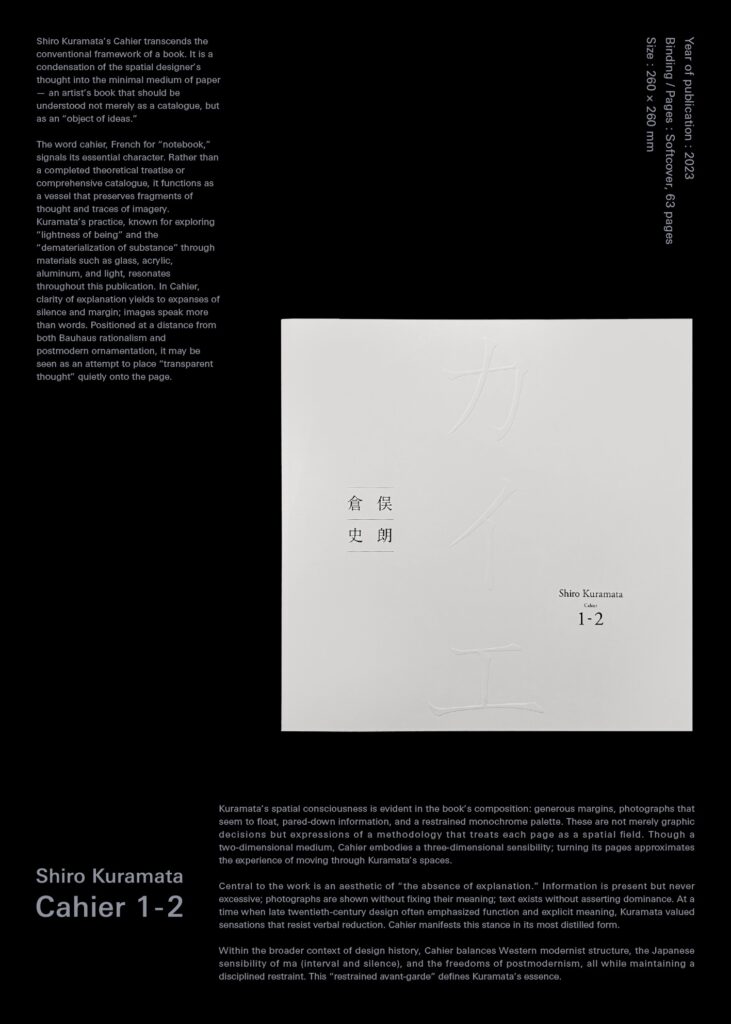
倉俣史郎の《カイエ(Cahier)》は、単なる書籍という枠を超えた存在である。それは空間デザイナーが“紙”という最小の媒体に自身の思考を凝縮したものであり、作品集であると同時に「思想のオブジェ」として捉えるべき一冊だ。
“Cahier”とはフランス語で「ノート」を意味する。完成された理論書や網羅的なカタログではなく、思考の断片やイメージの軌跡をそのまま留める器としての形式である点が重要である。倉俣の仕事は、ガラスやアクリル、アルミ、光といった素材を通して「存在の軽さ」や「物質の消失」を扱ってきたが、《カイエ》にも同じ思想が通底している。そこでは明確な説明よりも余白や静けさが重視され、言語よりもイメージが語る構造が選ばれている。それはバウハウス的合理主義とも、ポストモダン的装飾性とも距離を取りながら、“透明な思考”を紙上に静かに置く試みといえる。
ページ構成にも倉俣の空間意識が表れている。広い余白、浮遊するような写真配置、削ぎ落とされた情報、モノクロームの静謐さ。これらは単なるグラフィック上の選択ではなく、ページそのものを一つの空間として扱う姿勢の表れである。《カイエ》は平面媒体でありながら三次元的感覚を内包しており、本をめくる行為は倉俣の空間を歩む体験に近い。
また、そこには「説明の不在」という美学がある。情報は存在するが語りすぎず、写真は提示されるが意味を固定しない。文字はあるが、主張しない。二十世紀後半のデザインが機能や意味を積極的に語った時代にあって、倉俣は言葉に還元できない感覚を尊重した。《カイエ》はその姿勢を最も純粋なかたちで体現している。
さらにデザイン史の文脈で見るなら、《カイエ》は西洋的モダニズムの構造、日本的な「間」や儚さ、そしてポストモダンの自由さを内包しながらも、決して過剰に傾かない抑制を保っている。その“抑制された前衛性”こそが倉俣史郎の本質である。
ゆえに、《カイエ》は出版物でありながら一つの作品である。それは情報媒体ではなく、思考の彫刻、あるいは紙によるインスタレーションであり、倉俣史郎という存在の気配を静かに宿した美術的オブジェなのである。
Shiro Kuramata’s Cahier transcends the conventional framework of a book. It is a condensation of the spatial designer’s thought into the minimal medium of paper—an artist’s book that should be understood not merely as a catalogue, but as an “object of ideas.”
The word cahier, French for “notebook,” signals its essential character. Rather than a completed theoretical treatise or comprehensive catalogue, it functions as a vessel that preserves fragments of thought and traces of imagery. Kuramata’s practice, known for exploring “lightness of being” and the “dematerialization of substance” through materials such as glass, acrylic, aluminum, and light, resonates throughout this publication. In Cahier, clarity of explanation yields to expanses of silence and margin; images speak more than words. Positioned at a distance from both Bauhaus rationalism and postmodern ornamentation, it may be seen as an attempt to place “transparent thought” quietly onto the page.
Kuramata’s spatial consciousness is evident in the book’s composition: generous margins, photographs that seem to float, pared-down information, and a restrained monochrome palette. These are not merely graphic decisions but expressions of a methodology that treats each page as a spatial field. Though a two-dimensional medium, Cahier embodies a three-dimensional sensibility; turning its pages approximates the experience of moving through Kuramata’s spaces.
Central to the work is an aesthetic of “the absence of explanation.” Information is present but never excessive; photographs are shown without fixing their meaning; text exists without asserting dominance. At a time when late twentieth-century design often emphasized function and explicit meaning, Kuramata valued sensations that resist verbal reduction. Cahier manifests this stance in its most distilled form.
Within the broader context of design history, Cahier balances Western modernist structure, the Japanese sensibility of ma (interval and silence), and the freedoms of postmodernism, all while maintaining a disciplined restraint. This “restrained avant-garde” defines Kuramata’s essence.
Thus, Cahier is a work in its own right. It is not merely a vehicle of information, but a sculpture of thought—a paper-based installation that quietly carries the presence and aesthetic philosophy of Shiro Kuramata.