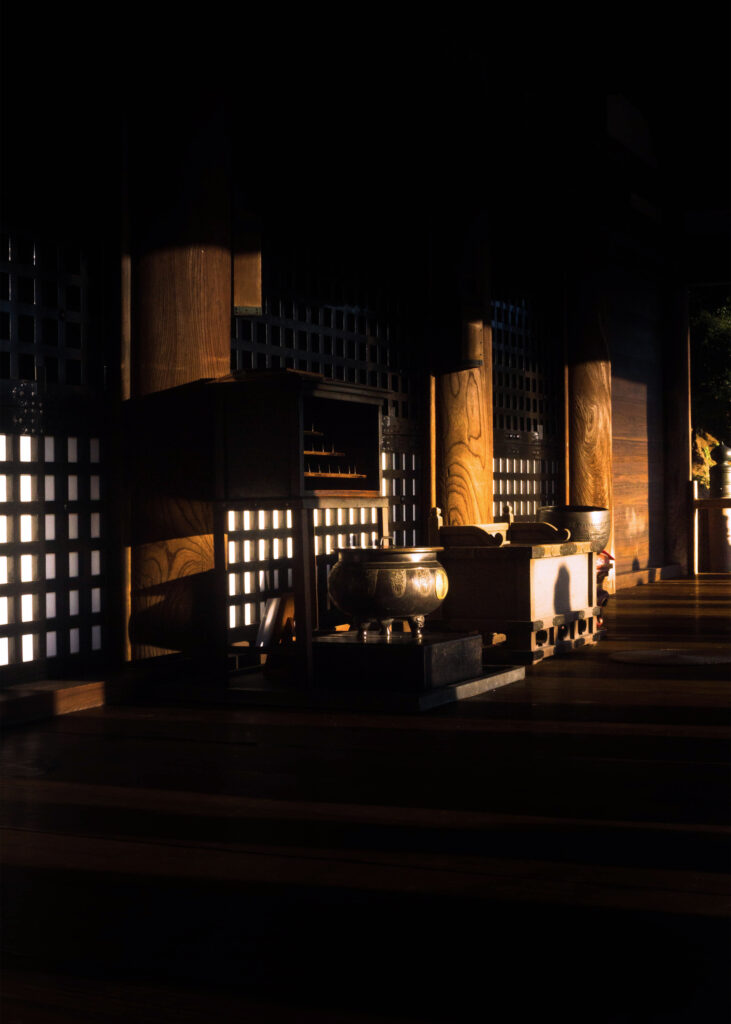
古来から続く参拝者の祈りが積もった場所として、影を“祈りの残像”に見立てた。清水寺・奥の院は、千年以上にわたり人々の祈りが行き交った場所である。
幾度も伽藍の再建を経ながらも、この地にたゆまず積もり続けたのは、建物そのものではなく、参拝者の“念”がつくり出した目に見えない層である。その層を「影」として捉え、光に照らされて初めて立ち上がる “祈りの残像” をテーマとした。
奥の院の木組みが落とす陰影や、静かに沈む暗がりには、時間が沈殿するような重みと、触れることのできない歴史の深さが宿っている。
I imagined the shadows as “afterimages of prayer,” a place where the prayers of visitors have quietly accumulated since ancient times.
The Oku-no-in of Kiyomizu-dera has been a crossroads of devotion for over a thousand years. Despite countless reconstructions of its temple buildings, what has steadily accumulated here is not the architecture itself,
but the invisible layers shaped by the intentions and prayers of those who came before.
By interpreting these layers as “shadows,”the work explores the theme of prayer’s afterimage—an essence that emerges only when touched by light.
In the shades cast by its wooden beams and in the stillness of its deepening darkness, one can sense a weight in which time has settled, and a depth of history that can be felt, yet never fully grasped.